

In today’s digital world, wellness apps have flooded the market, ranging from meditation, workout tracking, sleep, calorie counting, to mood tracking. Yet, despite millions of downloads, most wellness apps fail to keep users engaged after a few weeks. A study by Localytics found that over 70% of users stop using new apps within 90 days. So, the real challenge isn’t getting downloads, it’s keeping users engaged for a longer duration to reduce user drop-off. What makes some wellness apps disappear while others become a part of users’ everyday lives? The answer lies in the science of stickiness. A sticky wellness app doesn’t just attract users, it becomes part of users’ day-to-day life. It creates an emotional connection and becomes a trusted daily companion.
Why Online Presence is a Necessity for Nutritionists
Stickiness refers to how effectively an app retains users engaged and coming back over time. It’s not just offering good UX or fancy features — it’s more about user behavioural patterns Und habit formation.
Creating a “sticky” wellness app means developing a website and mobile application that works on the concept of how human motivation and habits actually work. High stickiness doesn’t just increase engagement — it brings retention, customer satisfaction, and long-term revenue growth.
Behavior-Oriented Ways that make a Custom Wellness App Fun and Engaging
1. Habit formation cycle: Cue → Routine → Reward
Every habit Stick to this simple three-stage cycle
- Cue: A signal that reminds the user to take steps (like a push notification).
- Routine: The action or habit itself (logging meals, meditating, exercising).
- Reward: The positive result & satisfaction that reinforces behavior (streaks, badges, or feeling energetic and proud).
2. Dopamine and Motivation
Humans crave progress. The brain releases dopamine when we experience growth or achievement even small ones.
Users are more likely to stay with an app that encourages small, achievable actions rather than intense tasks.
Small wins like “You’ve hit your 1000 steps goal for 3 days in a row! – that’s real progress”, it often motivates users more than rewards attached to big, long-term goals. Small achievements excite the brain and keep the user engaged for longer.
3. Designing for Engagement
Even the best habit-building approaches can fail if the user experience feels ordinary or obsolete.“Let’s see how good design can use a bit of human behavioural science to boost engagement.”
*Personalization
Every user’s wellness journey is unique. Use users’ data to tailor content based on their goals (e.g., stress management, improved sleep quality, Healthy weight control).
For example:
- “Eat healthier,” users get balanced meal plans.
- “Calm anxiety,” users get guided relaxation audios.
* User-friendly UI design
If your app isn’t easy to use, no amount of psychology will help.
Ensure smooth navigation, Adaptive designs for all devices, minimal sign-up steps, and effortless progress tracking to make users more likely to stay.
At AveryBit, we create simple and easy-to-use UI/UX designs that make wellness apps smooth and hassle-free.
4. Gamification
Gamification adds fun and motivation to fitness and healthcare journeys, turning exercises into goal-oriented games complete with ranking, rewards, and scores that motivate users to boost performance and hit daily workout targets .”
- Points and rewards for completing daily challenges.
- Levels or streaks to visualize progress.
- Friendly challenges or leaderboards to build consistency.
These features transform healthy habits into fun, rewarding experiences.
At AveryBit, our skilled team integrates custom gamification features —including Points & rewards, Customizable avatars & profiles, progress bars, and Social sharing of achievements— for wellness websites and mobile apps, increasing user engagement and promoting habit-building.
5. Social community
Humans are social animals. A little community support encourages users to stick to their goals. It’s easier to stay consistent and disciplined when you have people around you to support.
Adding community features, specifically like group challenges, discussion spaces, or social sharing, turns individual goals into common experiences.
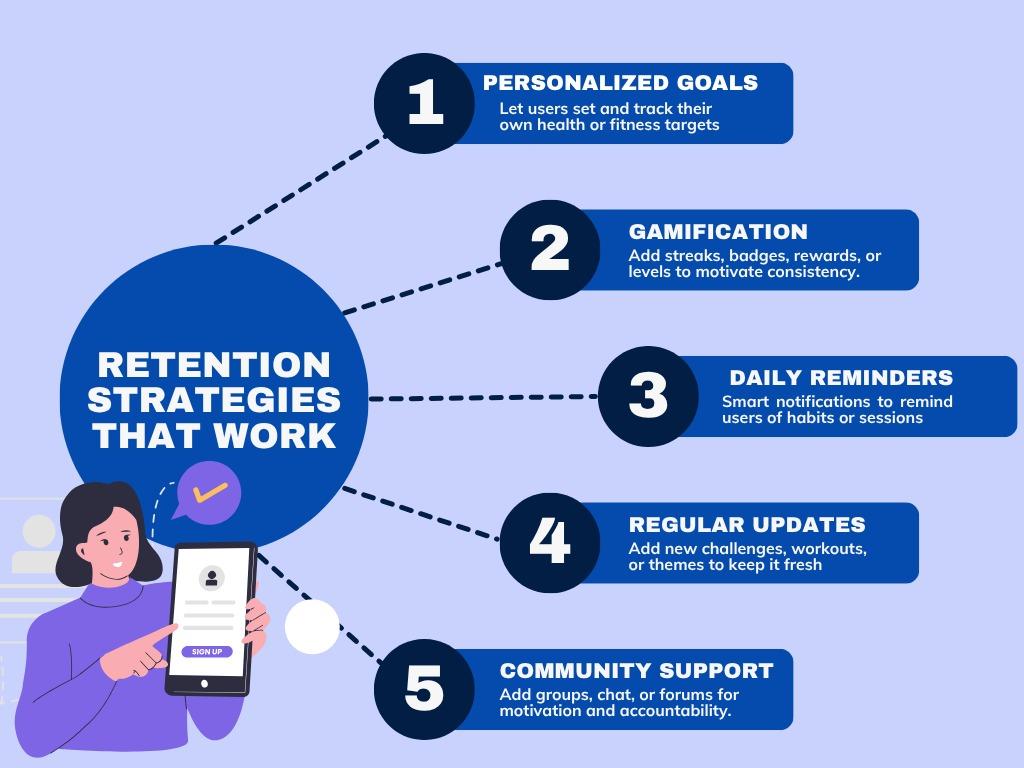
Retention Strategies That Work
- Push notifications that encourage, not Irritate.
- Email reminders celebrating progress.
- Fun challenges to keep users motivated & engaged
Regular content delivery (e.g., new yoga routines, recipes, or meditation audios).
A wellness app specifically designed for improving user engagement offers personalized features, rewards, and smooth experiences that align with their goals. When users enjoy using the app and feel an emotional connection, they’re more likely to stay involved and connected —helping reduce user churn and build long-term connections.
Bei AveryBit, we specialize in kundenspezifische Softwareentwicklung for the wellness, fitness, and healthcare industries. Building a wellness app that people actually use demands more than just coding — it requires a deep understanding of user mindset, UX design, and data security. That’s why we combine the expertise of our software development and marketing teams to create apps that not only bring users but keep them coming back with engaging, user-friendly features.
Our vision is to deliver brands uniquely crafted mobile apps or websites that are:
- User-friendly (easy-to-use, navigable, and minimalist)
- Sicher (Confidential, and privacy-first)
Engaging (User-focused, designed by user behavioral patterns ).












 German
  English