

Why Security Matters in AI Healthcare Apps
The field of artificial intelligence in the digital health sphere is evolving at an incredibly fast rate, with the use of predictive analytics and intelligent automation in healthcare apps becoming more efficient.
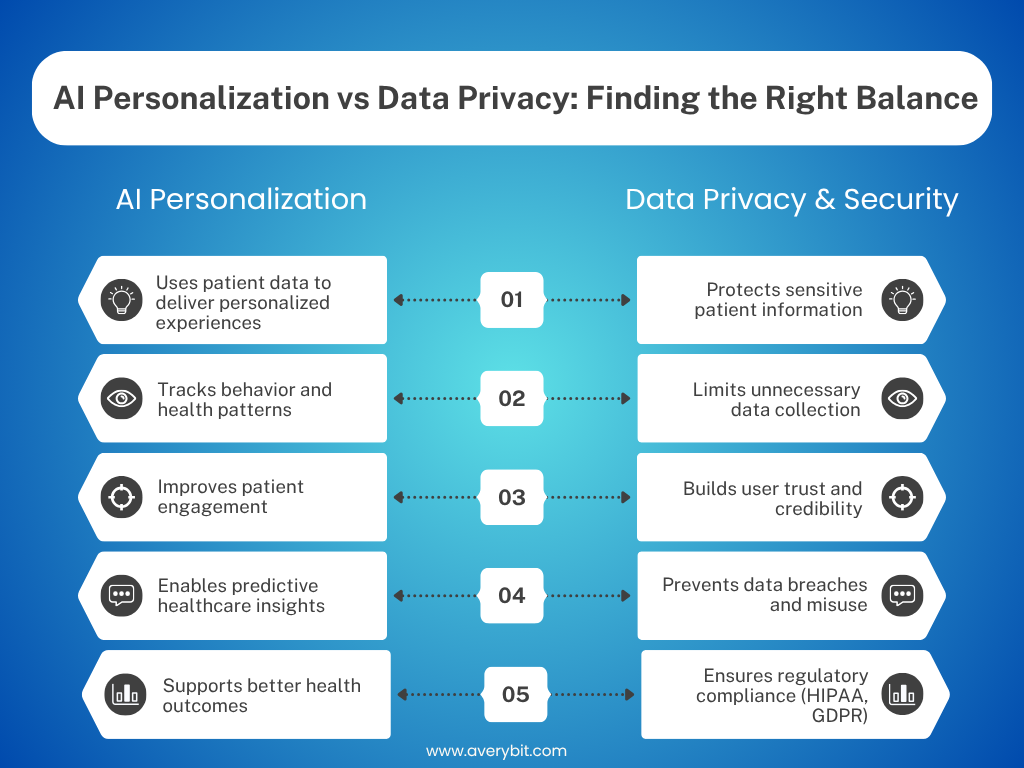
AI personalization in healthcare apps is also one of the major contributing factors to the evolving field of digital health, as it allows healthcare apps to provide the best experience to patients according to their needs.
But the use of personalization in healthcare apps relies heavily on the data of the patients, and that raises the concern of privacy.
For healthcare startups, it is not just the development of intelligent healthcare apps that matters, but also the security and trust that the healthcare apps provide to the patients.
This guide is all about the practical steps that are required to build secure healthcare apps that are powered by artificial intelligence and also provide the best personalization experience to patients in the health sphere.
Key Components Behind AI Personalization in Healthcare Apps
To build a safe and effective AI system, the startup should understand the key components of AI-powered apps.
Data Collection Systems
Healthcare apps powered by AI use data collected from patients, such as user data, wearable devices, and health records. The apps always aim to collect the least amount of data.
AI Model Integration
AI models process the collected data to generate insights, helping the apps make recommendations.
Secure Data Infrastructure
A strong backend system helps to unlock the safe storage of patient data by encrypting the data and allowing applications to access it.
These are the key components of safe AI-powered healthcare apps.
Step-by-Step Process to Build Secure AI Healthcare Apps
1. Define a Clear Healthcare Use Case
Start by identifying the problem your app will solve.
Whether it’s remote patient monitoring, mental health support, or chronic disease management, your use case will define your data and AI requirements.
2. Choose a Scalable and Secure AI Tech Stack
Your technology stack should support both performance and security.
This includes:
- machine learning frameworks
- cloud infrastructure
- healthcare APIs
The goal is to build a system that can scale while maintaining healthcare data security.
3. Design a Privacy-First Architecture
Security is an essential part of your system right from the start.
Some of the security features are:
- End-to-end encryption
- Secure authentication
- Role-based access control
- Secure APIs
4. Implement Advanced Privacy Technologies
Modern privacy technologies are essential to AI and data privacy in the healthcare industry.
These are:
- Federated learning (data is stored on the device)
- Edge AI (processing occurs on the device)
These are essential so that an AI can work without exposing raw patient data.
5. Ensure Regulatory Compliance
Healthcare applications must be compliant with the following regulations:
- HIPAA (Health Insurance Portability and Accountability) – US
- GDPR – Europe
These regulations are essential so that the privacy of patient data is maintained and there is no risk of legal issues faced by the startup.
6. Test, Monitor, and Improve Continuously
Security is an essential part of any application. Therefore, it is not something that is done once and forgotten.
Startups must ensure that there is continuous testing, monitoring, and improvement of the following factors:
- Test and monitor security
- Test and monitor performance
- Test and improve accuracy
Common Security Challenges in AI Healthcare Apps
Despite the right strategy, there are various challenges that may be experienced by the startup.
Data Breaches
Since healthcare data is valuable, it attracts cyber attacks.
Over-Collection of Data
Excessive data collected may expose the startup to risks, thus becoming difficult to comply with regulations.
Lack of Transparency
It is important to be transparent regarding the use of the collected data by the user.
AI Bias and Inaccuracy
The application of an untrained AI model may result in inaccurate insights, hence affecting the health of the patient.
Best Practices for Secure AI Healthcare App Development
To build reliable and scalable solutions, follow these best practices:
Collect Only Essential Data
Minimize data collection to reduce exposure.
Prioritize Patient Data Privacy
Make privacy a core part of your development strategy.
Use Strong Encryption
Protect data both in transit and at rest.
Maintain Transparency
Clearly explain how AI systems use patient data.
Conduct Regular Security Audits
Identify vulnerabilities early and fix them proactively.
These practices strengthen both security and user trust.
How Secure Development Enables AI Personalization in Healthcare Apps
The key to AI personalization is access to user data at all times, but this can also raise significant privacy risks.
This is where secure development can help by ensuring that the AI personalization is done in such a way that the data is protected.
Technologies such as federated learning enable the creation of AI-based patient insights using secure development.
This means that secure development is not just relevant but the key to the success of healthcare startups.
Learn more about this by checking out this article on AI personalization in healthcare apps.
Fazit
No longer is it simply about innovation, but also about responsibility.
It’s not just about building AI healthcare apps; it’s about building intelligent and secure healthcare apps. It’s possible to build highly innovative and powerful AI apps without compromising user trust.
As AI personalization continues to evolve and improve, so will the healthcare apps created by innovative and privacy-aware startups
Building Secure AI Healthcare Apps with AveryBit
If you are looking to build secure and scalable AI-based healthcare applications, then having the right technology partner can definitely speed up your journey to success.
AveryBit is here to help healthcare startups build secure and scalable AI-based healthcare applications.
Our team at AveryBit can help you design the architecture of your healthcare app and integrate AI-based technology.
Ready to build secure AI-based healthcare applications?
Get in touch with AveryBit and begin developing smart healthcare applications today!











 German
  English