

Healthcare marketing today is no longer about visibility alone. Patients, partners, and decision-makers evaluate trust long before they engage with a hospital or healthcare provider. Social media has become one of the strongest touchpoints in that decision-making process—but only when it’s used with clarity, consistency, and compliance.
This guide explains how B2B healthcare organizations, hospitals, and medical practices can build a HIPAA-compliant social media strategy that supports long-term growth, not short-term noise.
Why Healthcare Marketing Matters to Modern Practices
Healthcare is a trust-based industry. As opposed to any other industry, healthcare organizations cannot afford a second chance after losing trust.
Effective healthcare marketing has a direct impact on:
- Patient trust before the first consultation
- Online Reputation & Referrals
- Brand Authority in Competitive Marketplaces
- Long-term growth prospects for hospitals and B2B healthcare providers
Social media is a tool for healthcare brands to effectively educate, reassure, and remain visible without violating ethical and legal guidelines.
11 Proven Ways to Build a Healthcare Marketing Strategy That Works
Patient-Approved User-Generated Content
When used in an ethical way, patient stories and anonymized testimonials can lend authenticity. However, while there’s no question about approving, patient stories are more effective in creating a personality in healthcare brands compared to claims and commercials.
Increasing Engagement through Polls, Q&A, and Stories
Interactive modes encourage discussion without requiring personal revelations. Items such as polls, Q&A, and stories assist healthcare organizations in understanding concerns from patients while maintaining a professional rapport.
Educate, Don’t Just Promote
Education cedes authority more quickly than advertisement.
High-performing Healthcare Education Content Includes:
- Explain the procedure with simple words
- Generally, the breakdowns in
- Recovery timeframes and expectations
When people understand the “why,” trust comes automatically.
Clearly define what makes your practice different:
specialization, infrastructure, experience, or patient-focusedness – clarity around differentiation empowers decision-making for the patient and partner alike.
Engage in Active Fighting against Misinformation in Healthcare
Misinformation in healthcare spreads like wildfire. The opportunity to help dispel some of the more common myths with explanations that are clear and easy to comprehend will position your organization as a responsible and credible voice.
Lean into Short-Form Video in Healthcare Marketing
Short-format videos allow easy explanation of topics that might be complex. The explainers led by doctors, clips for raising awareness, and behind-the-scenes content perform exceptionally without sacrificing professionalism.
Create a secure, patient-dedicated community.
A well-moderated community is conducive to discussions and support. Clear guidelines, along with consistent responses, enforce transparency and build trust.
Develop a Standardized Healthcare Hashtag Campaign
Hashtags are discoverable only when used strategically. Using a combination of industry, local, and branded hashtags together helps in reaching the right audience without being promotional.
Leverage Ethical Influencer & Doctor Collaborations
Credible doctors, healthcare professionals, and local medical voices build trust faster than generic influencer marketing, particularly in B2B and hospital-led campaigns.
Share preventive health & awareness content.
The responsible tone of preventive care content speaks to more than business objectives. Awareness drives the recollection of a brand and its credibility in the long run.
Use of Social Listening to Understand Patient Concerns
Monitoring different conversations also shows repetitive questions, service needs, and rising trends, thus enabling healthcare brands to act “proactively” rather than “reactively.”
What Healthcare Marketing Data Tells Us
Although the particular metrics differ by region and platform, some patterns emerge that are
common across healthcare marketing:
- Educational posts tend to perform better than promotional posts in engagement
- Video explainers establish higher trust signals compared to static updates.
- Brands that respond consistently to comments increase their overall credibility
The bottom line is: quantity is secondary to clarity and consistency.
Understanding HIPAA in Healthcare Marketing
HIPAA outlines the use, disclosure, and protection of patient data. When it comes to social media marketing, personal data must be avoided, the use of social media platforms must be secured, and internal controls must be taken seriously, among other things.
Compliance is not a constraint; it’s a credibility signal.
How to Make Your Healthcare Marketing HIPAA Compliant
HIPAA-safe social media practices are:
Train Your Team on Digital Compliance
All individuals concerned with content creation must be aware of what is allowed and what is not.
Secure Platforms, Devices, and Data Access
Implement role-based access control, approved tools, and workflow security.
Act on Any Compliance Violations Promptly
Sound escalation policies provide a buffer for the patient and for brand reputation.
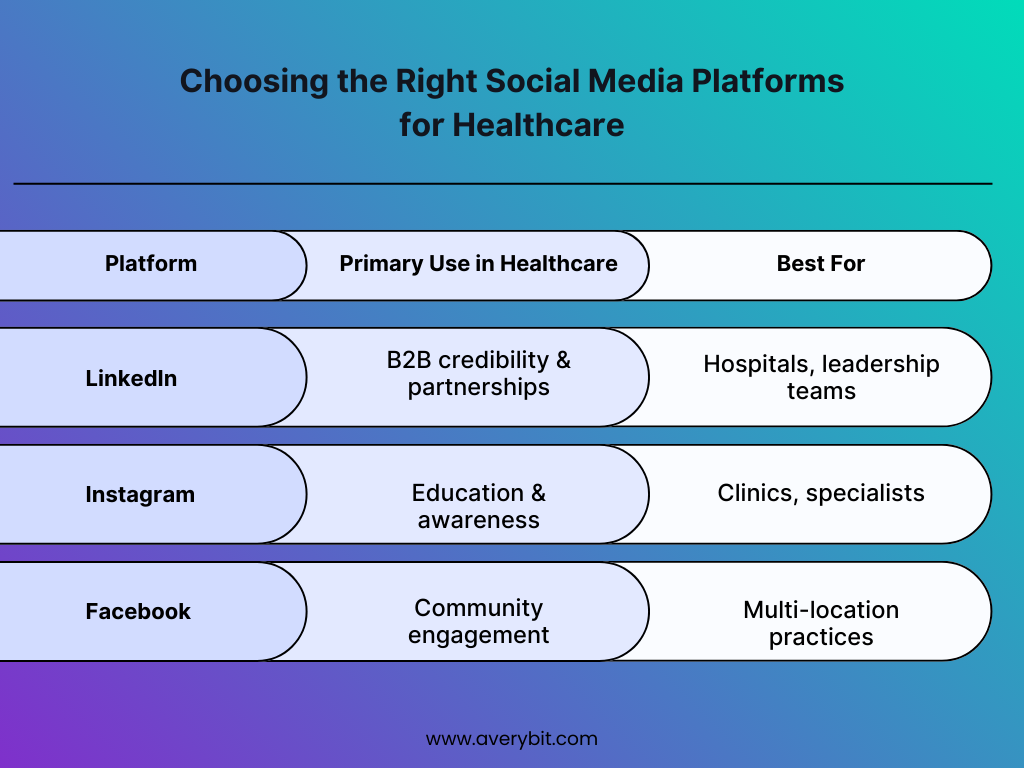
Selecting the Right Social Media Site for Healthcare
The purpose of each platform is not necessarily the same. Considerations should be made based on behavior and goals.
How Averybit Helps Healthcare Businesses Grow Smarter
Customer Acquisition & Conversion
Averybit assists healthcare organizations in reaching the right audience and driving desired outcomes.
Content Planning & Engagement
Streamlined workflows enable smoother planning, scheduling, and engagement activities while still maintaining compliance.
Reputation & Trust Management
Monitor the conversation, control the response, and maintain brand credibility.
Expansion & Localization
Run scaled campaigns that operate across several regions but have consistent messaging.
A Full Stack Growth Suite for Healthcare Teams
Averybit integrates automation, analytics, and compliance-aware workflows based on a single healthcare growth engine.
Conclusion:
Smarter Healthcare Marketing Starts with Compliance
Effective healthcare marketing is based on the concept of trust, consistency, and compliance – not quantity.
Thus, by leveraging the strategy and execution, the overall growth in credibility takes place while avoiding any regulatory risks.
If your healthcare marketing is in need of scaling without sacrificing compliance, then Averybit can assist you in developing appropriate systems to execute it in compliance.












 German
  English