

Every digital marketer and growth strategist loves data. We live in user behavior dashboards, and installing standard tracking scripts like the Meta Pixel, Google Analytics, or LinkedIn Insight Tags is usually our first step after launch. On a standard e-commerce or B2B SaaS website, this is considered brilliant, data-driven engineering.
In a HealthTech application or patient portal, however, it is an absolute compliance disaster waiting to explode.
When a patient logs into a health platform to look up a specific medical condition, manage symptoms, or book an appointment, invisible third-party pixels running in the background operate automatically.
They don’t just track anonymous clicks; they bundle that specific search query or button action with the user’s IP address, browser fingerprint, and sometimes personal identifiers, transmitting it straight to advertising platforms.
Under HIPAA regulations and federal privacy frameworks, this isn’t just “marketing analytics”; it is an unauthorized disclosure of Protected Health Information (PHI).
Regulatory bodies and aggressive class-action legal firms are actively squeezing this exact loophole right now. Legal teams are auditing digital health websites that silently leak consumer behavior through unconfigured tracking scripts.
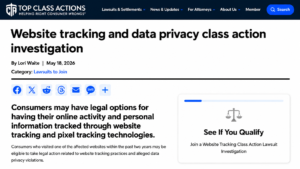
Source: Top Class Actions Legal Directory (Active June 2026 Investigations)
Before analyzing recent multimillion-dollar penalties, take the Free HIPAA Readiness Audit to map your hidden vulnerabilities and find your risk tier in just 6 minutes.
Putting It All Together: How This Legal Investigation Will Impact Founders
If you believe that this latest wave of class-action lawsuits will fade with time, examine the currently active legal investigation metrics provided by this legal snapshot from June 2026. This is not a bunch of legacy class actions from years gone by – it shows that the legal industry is alive and well and pursuing modern-day health technology platforms.
The legal industry is openly encouraging consumers to join mass torts and class-action litigation once they realize that their activities have been reported via apps to consumer advertisement networks without their permission.
The penalties faced by startups because of architectural design flaws are now shifting from simple warning letters to civil monetary penalties Und legal action. Since your legal investigation tracker is already performing its audit of your scaling tech platform this month, you cannot afford to rely on your current tracking architecture any longer. While you may believe that your platform is entirely safe, a single line of third-party JavaScript code can bypass your entire cybersecurity framework.
The True Cost of “Standard” Analytics: Recent Multi-Million Dollar Precedents
To understand the scale of the financial and reputational damage we are talking about, we need to look at the real-world precedents set by healthcare brands and telehealth providers. These organizations treated tracking pixels as harmless marketing tools, only to face massive federal crackdowns and legal settlements.
The legal precedents established over the recent quarters prove that courts and federal agencies are completely rejecting the “we didn’t know how the pixel worked” defense from executive teams:
HealthTech / Hospital Brand | The Inadvertent Action | The Financial & Legal Consequence |
BetterHelp | Shared user health intake queries, emails, and mental health histories with Snapchat, Facebook, and Pinterest for retargeting campaigns via marketing pixels. | $7.8 Million FTC Settlement paired with a strict, permanent ban on sharing consumer health data for advertising. |
Inova Health Care Services | Embedded third-party tracking pixels inside their secure, public-facing patient portal (MyChart) to optimize digital patient registrations. | $3.14 Million Class-Action Settlement (Finalized April 2026). |
Northwell Health | Implemented Meta Pixel and Google Analytics code on patient scheduling and provider-search pages without explicit consumer authorization. | Class-Action Privacy Settlement (Claims processing officially closed April 2026). |
Legacy Health | Unknowingly transmitted patient portal authentication behavior, login attempts, and navigation tracking to Meta and Google servers. | Class-Action Privacy Settlement (Final court approval timeline reached April 2026). |
Technical Realities: Client-Side Leaks vs. Server-Side Control
Der fundamental mistake product teams make is treating healthcare data pipelines like consumer retail funnels. When you load a tracking pixel directly in the user’s browser (client-side), you lose control over what that script collects. It automatically scrapes metadata, URLs, and input fields.
To maintain high-performance marketing attribution without turning your app into a compliance liability, your engineering team must restructure your data flow.
The following framework outlines how product managers can transition from high-risk tracking setups to compliant, high-performing growth architectures:
Deep Insightful Strategy Table:
Risk Area | High-Risk Standard Setup (The Trap) | Compliant High-Performance Setup (The Solution) | Business & Marketing Impact |
Data Collection Method | Client-Side Browser Pixels: Third-party scripts execute directly in the patient’s browser, automatically scraping URLs, form inputs, and IP addresses. | Server-Side Tracking Environment: Scripts send data first to your secure, dedicated cloud server (e.g., custom Google Tag Manager Server container). | Completely isolates user data. Third parties only receive what you explicitly choose to forward. |
Data Scrubbing & Masking | None: Raw data packages containing Protected Health Information (PHI) and user identities are sent straight to Meta, Google, or TikTok ad managers. | Automated Data Redaction: Before data leaves your cloud server, an automated proxy script strips out IP addresses, medical parameters, and personal details. | Drops your compliance risk to near zero while still allowing basic conversion events to register. |
Platform Vendor Agreements | Standard Terms of Service: Accepting generic click-through privacy policies on ad networks that explicitly forbid sending them health-regulated metrics. | Enforced Business Associate Agreements (BAAs): Utilizing analytics platforms (like specialized cloud vendors) that legally sign a BAA. | Establishes absolute legal protection. Note: Consumer ad channels will never sign a BAA for standard tracking. |
Actionable Steps: How to Audit Your Platform Before an Auditor Does
If your goal is to protect your platform from appearing on active litigation trackers, your technical team needs to run an immediate, end-to-end data-flow audit. Do not wait for a quarterly security review. Implement this three-step verification process immediately to identify and isolate hidden marketing scripts:
- Map Every Single JavaScript Network Request: Use advanced browser developer tools to run an exhaustive audit on your user forms, booking confirmation pages, and post-login dashboards. Document exactly where data packets route the millisecond a user clicks a call-to-action button.
- Decouple Marketing Pixels from the Frontend: Move your analytics structure entirely to a server-side framework. By routing frontend interactions through an intermediate cloud proxy under your direct ownership, your engineering team can completely filter out sensitive healthcare metrics before sending clean, aggregated conversion volumes to external ad platforms.
- Audit Your Vendor Ecosystem for BAAs: Review every single marketing technology tool integrated into your app code. If a third-party software platform processes, tracks, or touches user interaction data streams, they must sign an official Business Associate Agreement. If they refuse, remove their scripts from your ecosystem immediately.
The Bottom Line: Secure Your Data Before It’s Too Late
Look, you don’t need to stop tracking your app’s performance or run your business completely blind. You just need to stop using old-school, client-side tracking pixels that casually leak your users’ private health data to big tech platforms.
Fixing your tracking setup today isn’t just about avoiding a massive federal fine; it’s about building trust with your users and making sure your next big enterprise deal doesn’t fall through because of a sloppy compliance mistake.
If you haven’t checked your app’s exposure yet, take 2 minutes to run it through our HIPAA Risk Calculator. It will show you exactly where your tracking data is leaking and what you need to fix right away.












 German
  English