
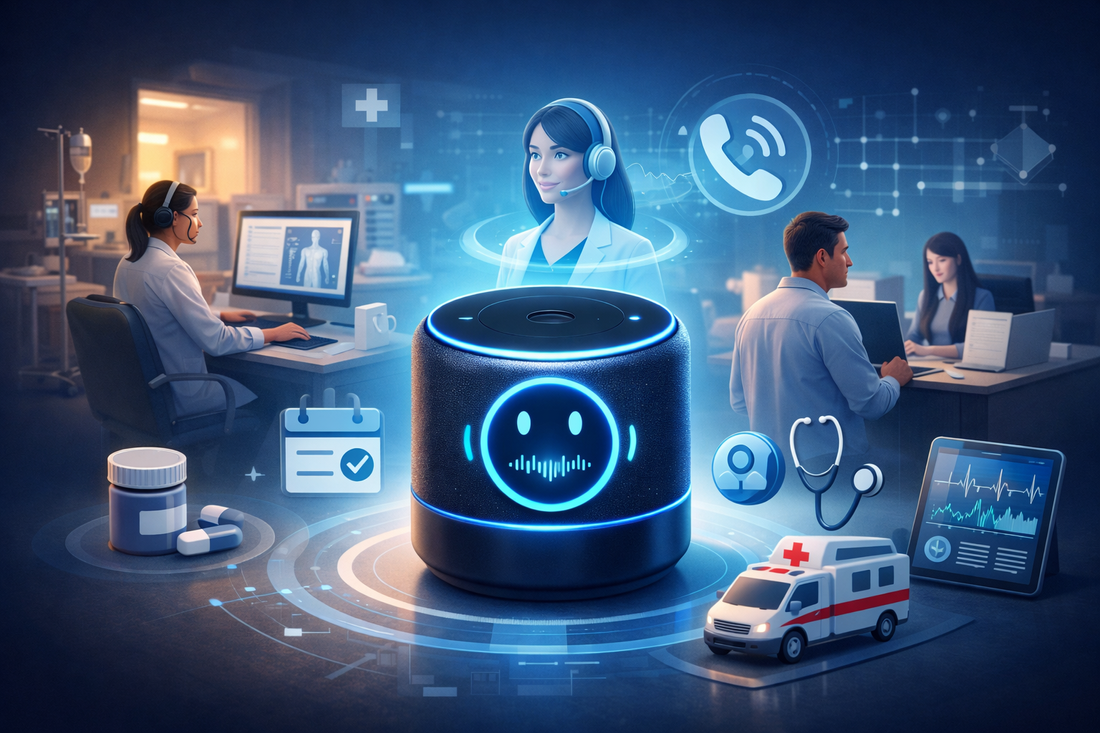
Healthcare systems today aren’t struggling due to a lack of medical expertise.
They’re struggling with communication inefficiencies.
Missed patient calls. Overloaded front desks. Long wait times.
And patients who move on simply because they couldn’t get a timely response.
This is where AI voice agents for healthcare are becoming a critical operational solution.
What Are AI Voice Agents for Healthcare?
AI voice agents are intelligent systems that are designed to manage patient interactions via voice-based interactions.
The capabilities of AI voice agents include:
Answering all incoming calls
Scheduling appointments
Responding to patient inquiries
All this without the need for human intervention.
The Real Problem: Why Healthcare Communication Breaks Down
The challenges faced by most healthcare facilities are the same, such as:
Missed Calls = Lost Patients
During peak hours, a healthcare facility can lose a substantial number of calls, resulting in lost patients.
Front Desk Overload
Hours of repetitive calls can be a waste of time, which could have been used to focus on patients
Limited Availability
The availability of support is limited to only working hours.
Inconsistent Patient Experience
The experience of patients can be affected due to the waiting times.
How AI Voice Agents Can Help Solve the Challenges
AI voice agents can address the above issues in the following ways:
Automated Call Handling
Every patient call is answered immediately.
Smart Appointment Scheduling
Patients can schedule, reschedule, or cancel appointments without the need for any staff.
24/7 Availability
The facility can be made available without incurring additional staffing costs.
Intelligent Call Routing
Complex calls are routed to the appropriate department.
Key Use Cases of AI Voice Agents in the Healthcare Industry
There are various use cases for AI voice agents in the healthcare industry, including:
Appointment Booking & Reminders
This helps to reduce no-shows.
Patient Follow-Ups
This helps to automate the process.
Prescription Refill Requests
This helps to automate the process.
Call Triage
This helps to determine urgency levels.
AI Voice Agents vs Traditional Call Centers
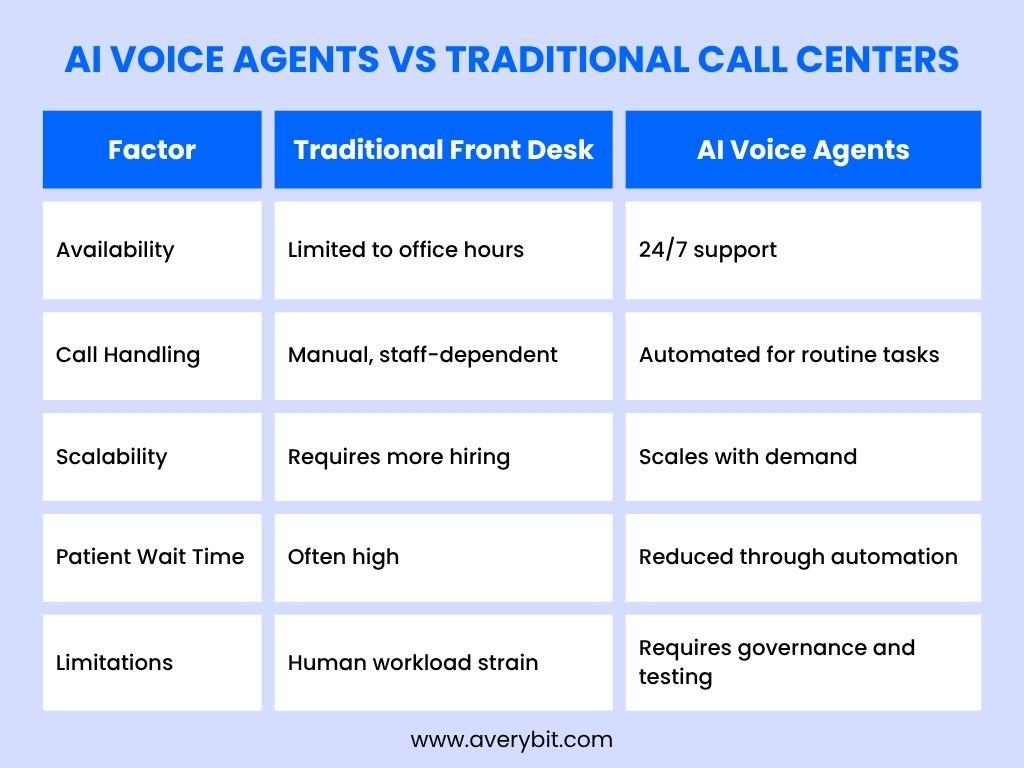
AI doesn’t replace healthcare staff, it removes repetitive workload, allowing teams to focus on critical care.
Benefits for Healthcare Providers
The use of AI voice agents in the healthcare industry offers several benefits, including:
Reduced Operational Costs
This is because there is no need to maintain a large team at the front desk.
Improved Patient Experience
This is because of the faster response times
Increased Staff Productivity
This is because the team can focus on other, more important things.
Measurable Efficiency Gains
Many healthcare providers see a significant reduction in no-shows within a few weeks of using the solution.
Compliance and Security Considerations
Automating healthcare requires responsible consideration.
Key considerations include:
- Data privacy and encryption
- Secure system integrations
- Compliance with healthcare regulations (e.g., HIPAA)
A properly designed AI system will be efficient and provide data security.
How to Successfully Implement AI Voice Agents
The key to the successful implementation of AI voice agents is not the technology, but the strategy.
High Impact Use Cases
Focus on:
- Appointment handling
- FAQs
- Call Routing
Integrate with Existing Systems
Compatibility with existing systems is essential.
Continuous Optimization
The more AI is used, the more it improves.
Human Escalation
The ability to escalate calls is essential.
How AveryBit Can Help
AveryBit is here to assist healthcare organizations in creating and delivering AI voice agent solutions that meet the needs of each organization.
Our process is centered around:
- Development of custom AI voice agents
- Integration with existing healthcare systems
- Automating workflows to ease the burden
- Developing scalable solutions for long-term efficiency
The goal is simple: better patient interactions and less strain on the operations.
The Strategic Advantage
Healthcare is rapidly moving toward automation-driven operations.
Organizations adopting AI voice agents early benefit from:
- Faster patient response systems
- Reduced operational costs
- Improved patient retention
This is no longer a future trend; it’s becoming a standard in modern healthcare infrastructure.
Conclusion
AI voice agents are not simply an enabler.
They are an essential operational upgrade for healthcare providers.
As patients demand more and systems get more complex, efficient communication is no longer a nice-to-have.
Healthcare organizations that implement AI-driven communication solutions today will be poised for success in the future.
FAQs
How reliable are AI voice agents in the healthcare industry?
Yes, they can efficiently manage most routine interactions with patients if implemented well.
Do they replace human staff in the hospitals?
No, they improve the productivity of the staff.
How cost-effective is it?
Yes, it is cost-effective, especially in the long run.
Can they be integrated with existing systems?
Yes, they can be integrated with existing systems.











 English
  German