
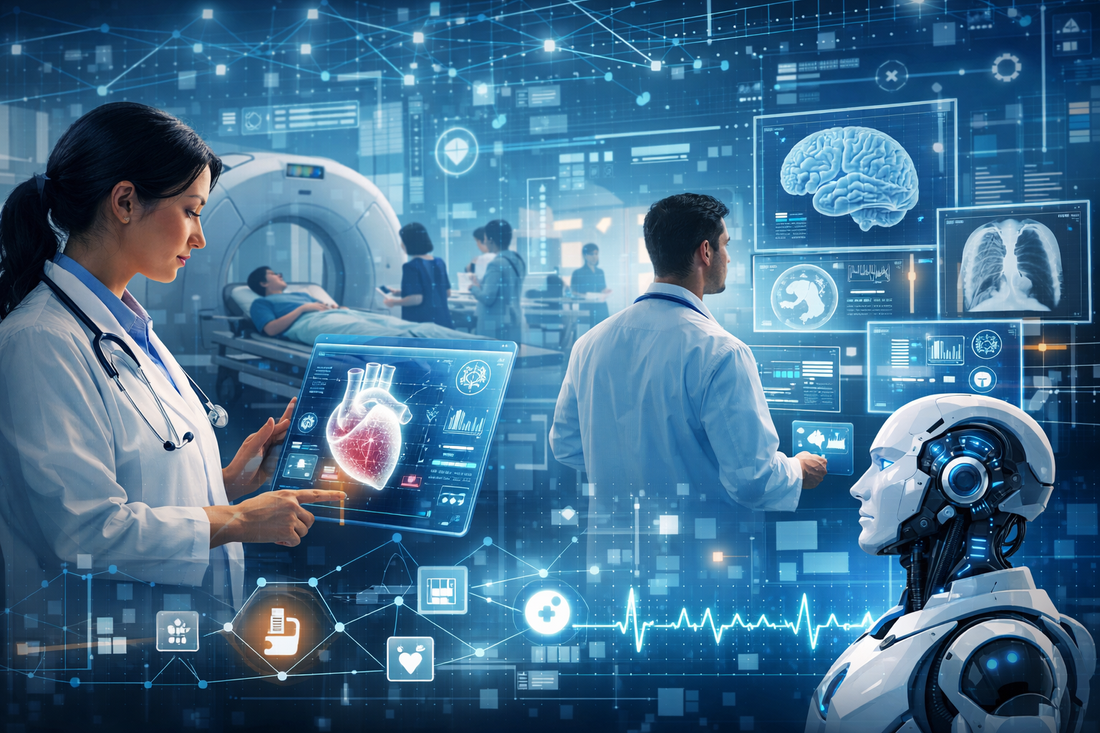
Artificial Intelligence (AI) is revolutionizing the way we receive healthcare the same way it has transformed every other aspect of our lives. Among these technologies being introduced into modern hospitals, AI Diagnostics would be considered a big part of what has moved hospitals’ services toward ‘Digital Transformation’. Hospitals of today have stopped utilizing traditional processes and begun to use AI Diagnostic technology to increase their ability to provide timely, accurate, and personalized care. Health care organizations now use AI technologies to create streamlined processes and help improve the efficiency of hospitals and the quality of care patients receive.
AI technologies are changing the way clinicians think about caring for their patients—from finding signs of disease at an earlier stage through the use of incorporated predictive analytic models to providing better, faster, and more accurate care for each individual patient. By leveraging both data analytics and intelligent hospital systems, healthcare providers now have the ability to offer safer, quicker, and more precise care to each and every patient.
How AI-Powered Diagnostics Drive Hospital Digital Transformation
Integrating Artificial Intelligence with the Diagnostic Process is Changing How Hospitals operate. With the help of AI in Diagnostics, hospitals can process large amounts of patient care data in real-time to identify trends, patterns & anomalies much faster than through traditional means. As a result, AI helps to decrease diagnostic errors, speeds up Treatment Plans & improves overall Patient Safety & well-being.
Hospitals that use these new technologies are creating smart hospital systems. These systems represent an evolution of the hospital’s Digital Ecosystem—the web of interconnections between the hospital’s different departments through the use of Interoperable & Accessible Electronic Health Records, Imaging and Lab Results.
Enhancing Clinical Decision-Making
Clinical decision support systems (CDSS) are integral to AI Driven Diagnostics. CDSS uses evidence-based practices to guide Clinical Decision-Making. In addition to providing a guideline for Clinical Decision-Making, CDSS supports clinicians by identifying Potential Patient Risk Factors and suggesting options for Personalized Care for patients.
Predictive diagnostics are the next logical evolution for AI in Diagnostics. With Predictive Diagnostics, clinicians can detect potential problems in patients before they present themselves. Examples of this are:
- Early detection of Heart Irregularities may prevent Heart Attacks.
- The use of AI to Predict Potential Infection Risk allows for Preventative Care.
The use of AI changes the healthcare paradigm from Reactive to Proactive in nature, with the potential to Improve Patient Outcomes and Hospital Efficiency.
Full H2 Secure Patient Platforms vs. integrated secure patient platforms
Secure patient platforms provide patients access to their medical records and a way to schedule appointments and also communicate safely with their providers. However, there are two ways to implement secure patient platforms.
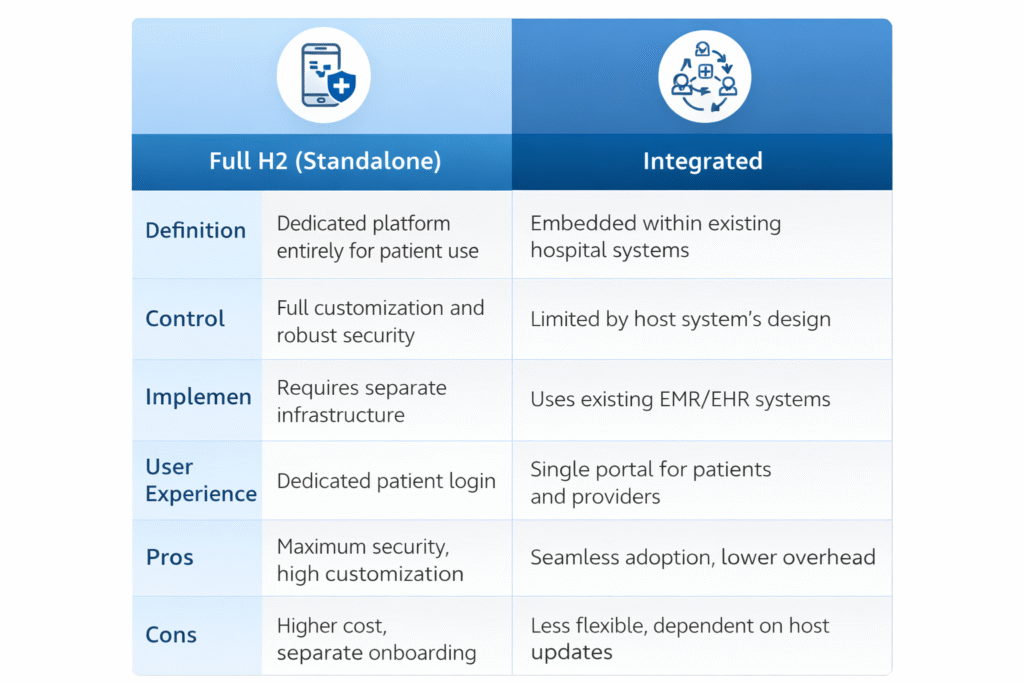
Choosing the right platform depends on priorities: Full H2 is oriented around empowering patients to take control and manage their own data while maintaining the security of that data; while Integrated is oriented towards increasing workflows and convenience for how a provider does their job.
Intelligent Infrastructure and Smart Hospital Systems
AI will shape the future of healthcare through the use of smart hospital systems. These systems connect devices with medical equipment and data streams, enabling hospitals to provide optimized operational efficiencies and deliver improved levels of patient care. Smart hospital systems also improve the workflow of the hospital, allowing the AI algorithms to help achieve all these objectives by providing priority to a clinician’s tasks; by monitoring a patient’s vital signs in real time, allowing clinicians to monitor patient vital signs and intervene when there has been a change in a patient’s condition.
An intelligent hospital infrastructure allows clinicians to use technology to support their work, with technology enhancing rather than replacing clinicians. An example of this is the ability of smart monitoring devices to provide alerts in real-time so that clinicians can take action when there are changes in a patient’s condition. The use of artificial intelligence-powered diagnostic tools in smart hospital systems enables hospitals to provide accurate, efficient, patient-centered care.
Interoperability: Providing Patients with Seamless Care
Interoperability, in the context of smart healthcare delivery systems provides an electronic connection between the laboratory and the pharmacy to enable more efficient processes to be completed. By partnering with artificial intelligence (AI), interoperability enhances the ability of hospitals to provide high-quality care while also enabling hospitals to effectively manage and maintain a high volume of patients.
Future of AI, Powered Diagnostics and Predictive Healthcare
Healthcare’s future lies in predictive, data-driven models. AI-powered diagnostics are going to be able to predict patient needs before symptoms are even visible.
This will facilitate preventive care and offer more personalized treatment plans.
Emerging trends include:
- Machine learning algorithms for predictive analytics
- AI-driven hospital workflows
- Integration with smart hospital systems for real-time decision making
Healthcare AI solutions are the key drivers of these pharmaceutical innovations that fundamentally change hospital operations and the patient experience. Going forward, digitization in hospitals will be very much visible.
Conclusion
AI-powered diagnostics have become a must; they are the core of modern healthcare. Equipped with patient secure platforms, smart hospital systems, and interoperable infrastructure, hospitals will be able to raise the quality of care, simplify operations, and gain patients’ confidence.
By incorporating healthcare AI solutions, hospitals are not only adapting to the future but are also ready to offer accurate, efficient, and patient-focused care in a rapidly changing digital world.
At AveryBit, we build custom software for the wellness, fitness, and healthcare industries.
Creating apps people actually use takes more than development, it requires insight into user behavior, intuitive UX, and strong data security.
That’s why our engineering and marketing teams work together to deliver scalable, engaging products designed for long-term adoption.




 English
  German