

If you’re a mental health provider who wants to develop your own software solution, the first question usually asked is: how much will it cost?
That’s a good question and one that is answered in many ways; however, there isn’t a single price point that fits every software project due to several criteria unique to your organization, business, and regulations. I.E. You need assistance in determining what those elements are to help you create a more budget-conscious plan than purchasing commercial off-the-shelf software packages.
Why Behavioral Health Software Is More Complex to Build
Each type of health industry system has its own requirements, and therefore, not all types of mental health software packages are the same compared to other types of systems. Normal software development companies generally cannot meet many of the specific needs of mental health software.
Clinical documentation also looks different: therapists typically do not use simple check boxes and write narrative notes using formats like SOAP, DAP, and BIRP, and your software needs to support these. In addition, there are compliance regulations as described above that apply, with HIPAA requirements as well as 42 CFR Part 2, the Federal Regulations governing the sharing of substance use disorder patients’ records. Missing this requirement in your architecture typically will not be a ‘small fix’, but could require major reengineering of key components of your software.
All this means that behavioral health software takes more planning, more specialized development, as well as greater thoroughness with compliance testing than an ordinary software project. This complexity is what drives the overall cost. In most cases, the best approach is to clarify what is in scope for the emotional/mental health services so the project can progress forward accordingly.
The Factors Impacting Your Budget
While providing you with a raw number is useful, understanding the variables that will affect your investment will be much more beneficial to you.
Feature Scope –
A minimum viable product (MVP) consisting of scheduling, clinical notes, secure messaging, etc., is going to cost significantly less than a complete platform that includes Telehealth, billing management, e-Prescribing, and patient-facing mobile apps. The broader your features, the more you will pay and the longer the project will take.
Build vs buy vs hybrid–
A fully customized build gives you full control over your product, but it is a bigger investment than an off-the-shelf solution. Off-the-shelf solutions have a quicker time to implement and a lower up-front cost, they do not always match your current workflows. A hybrid model, which uses a configurable core and custom modules, is usually the most cost-effective solution for mid-sized companies.
Integrations–
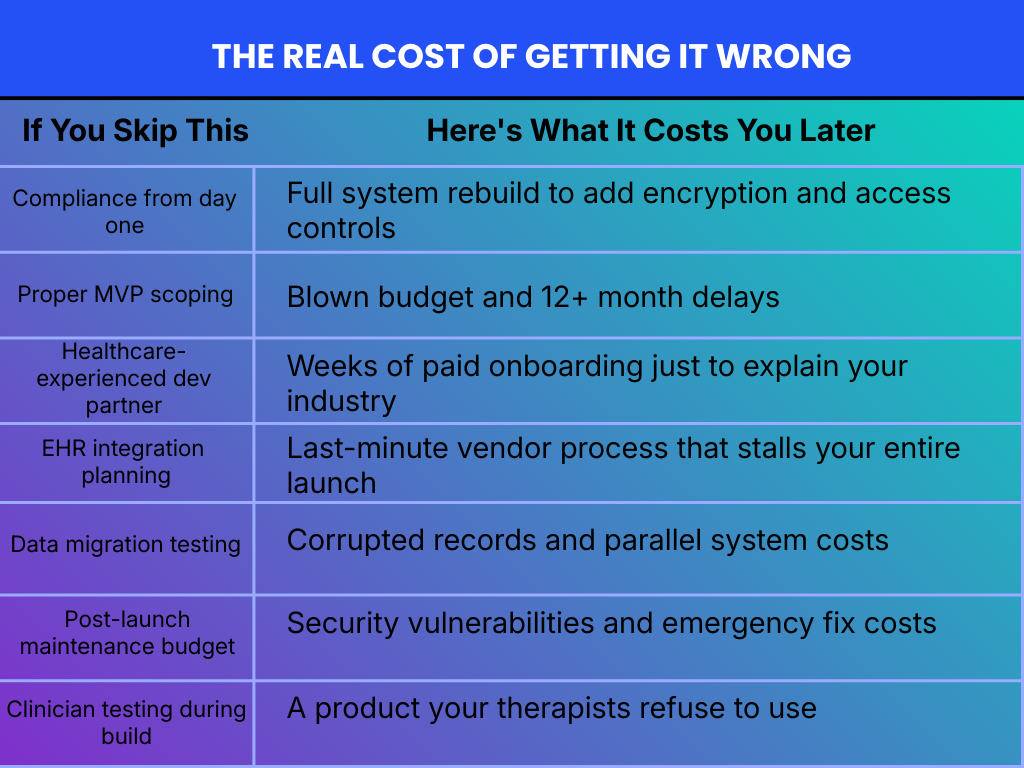
Connecting your platform with existing EHR systems (e.g., Epic, Cerner) or integrating with insurance payers for billing creates a lot of complexity, and these integrations will require vendor partnerships and a significant amount of development time, so they should be factored into your budget from day one.
Compliance architecture –
Security cannot simply be added to your product as an afterthought; security measures such as encryption, role-based access controls, audit logging, and multi-factor authentication must be part of your system from the very first sprint. Organizations that consider this in the background of their planning often spend significant resources correcting for it later.
Your development partner –
Partnering with a development team that has an existing understanding of your industry (behavioral health workflows, HIPAA policies, clinical documentation, etc.) will save time and money compared to partnering with a general software developer that does not know any of these basics about your industry before developing your product.
How Should You Create Your Budget?
Order of priority: Start with a clear understanding of what your MVP version is. What is the most basic version of your platform that will satisfy your clinicians and patients to address their primary pain points? Build this version first, build it well, and then continue to enhance that MVP version by adding other value-added features to your MVP platform. The more features that you add to your original scope of development, the more your costs will increase, lengthen your project timelines, and increase the risk of project delays.
Choose a development partner with real healthcare experience (they must have experience asking the right questions before writing any code!) and ensure they view compliance as a foundational part of your project, not just another final checklist item.
The cost of developing your behavioral health software will ultimately be determined by what you do to set up for success before you begin building out your platform. Organizations that invest in proper discovery, realistic scoping, and building the right partnerships typically receive more value for their money than those who do not, and they are less likely to encounter costly surprises that can quickly derail a project and its associated costs, due to skipping those initial steps.
Are you ready to build your behavioral health software platform the right way?
If yes, then visit AveryBit! At AveryBit, we are experts in developing healthcare software solutions that are compliant, scalable, and designed with how clinicians and operations staff actually work. Whether scoping out your minimum viable product (MVP) or rolling out an enterprise-wide solution, we can provide the necessary skillset and knowledge of the healthcare industry to deliver successful outcomes without incurring any unexpected costs associated with your behavioral health software development project.
Let’s talk about your project today! Schedule your FREE consultation with AveryBit.











 English
  German