

There is currently an increased interest in the application of AI in the provision of healthcare not only to improve efficiency and decrease bureaucracy, but also to enhance the quality of services provided.
The need for such changes is due to the desire of healthcare facilities to find solutions to high costs and heavy workloads faced in today’s environment.
The importance of the matter was confirmed in recent findings in relation to artificial intelligence from a U.S. federal initiative in the area of healthcare.
In particular, it became evident that there is a need to provide proper guidance, governance, and regulations for AI implementation in healthcare.
A Step Toward Responsible AI Adoption
Over 7,000 people responded to the survey conducted by various hospitals, researchers, and technology firms.
Furthermore, Some key issues that were mentioned in the feedback include:
- More coordinated actions between health care organizations
- Governance and proper guidelines for implementing AI
- Standards for evaluation of AI systems
- Patient safety and privacy
This initiative shows that AI should not only be focused on administration but also in the areas where it can make a positive impact clinically.
Why This Matters
Significance of AI in Healthcare.
Therefore, The need for healthcare institutions to be efficient and still offer quality healthcare is continuous.
The use of AI can help achieve that through reduced administrative tasks, decision support for clinicians, and communication between the institution and patients.
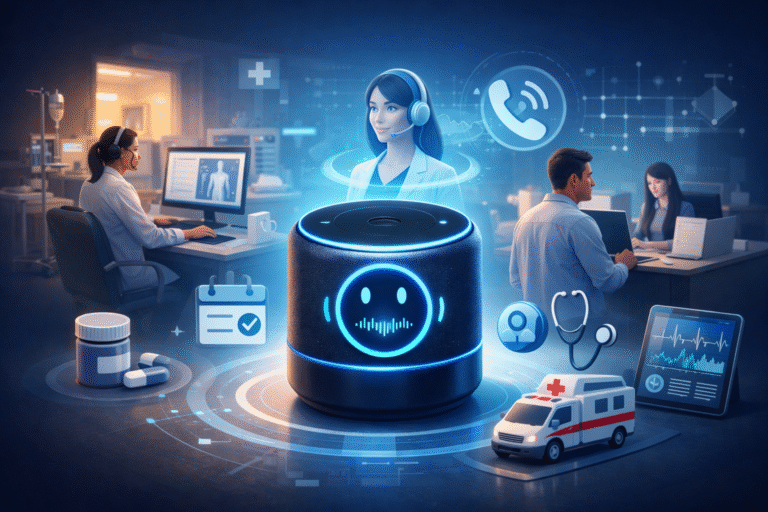
Key Use Cases of AI in Healthcare
Some of the common uses of AI in healthcare are as follows:
- Clinical documentation
- Appointment booking
- Medical coding and billing
- Virtual health assistants
- Clinical decision support
When implemented thoughtfully, these solutions can save time, reduce operational costs, and allow healthcare professionals to spend more time with patients.
These Challenges Cannot Be Ignored
Whereas AI provides many opportunities, there are some responsibilities that come with it too.
Moreover, The healthcare institutions must make sure that any AI system being used has proper protection mechanisms for patient data and complies with all regulations, including HIPAA.
Also, the AI model needs to be constantly tested to avoid inaccuracy, bias, and decline in its performance.
Whereas AI is integrated into a healthcare solution that can be considered a medical device, additional FDA requirements may apply as well.
The establishment of trust is equally crucial as the development of a solution.
Getting Ready for the Future
It is not necessary for companies to adopt AI right away everywhere.
Hence, The most pragmatic way would be to start off by adopting AI through some high-impact use cases such as administrative automation or patient engagement before moving on to more sophisticated clinical uses.
Some other key considerations for health care leadership would include:
- AI governance policies
- Data security
- AI usage training
- Performance evaluation of AI
Partnership with IT vendors who have a good understanding of healthcare regulations.
Conclusion
The bigger picture at the federal level indicates that AI is becoming an integral part of the future of healthcare.
Nevertheless, implementation of AI technology requires being done securely and responsibly to achieve better results from its use in practice.
Ultimately,Organizations in the health care industry which adopt a strategy of responsible AI now will be better prepared for the future regulations and able to provide better patient-centered services.
Source: The material used in the article is based on the information provided by the U.S. federal healthcare organization concerning its Artificial Intelligence Request for Information (RFI).
1. What is responsible AI in healthcare?
Responsible AI in healthcare refers to the development and use of artificial intelligence in a way that is ethical, transparent, secure, and compliant with healthcare regulations. It focuses on protecting patient privacy, reducing bias, ensuring human oversight, and improving healthcare outcomes while maintaining trust.
2. How can healthcare organizations use AI safely?
Healthcare organizations can use AI safely by implementing strong data security measures, complying with HIPAA regulations, validating AI models regularly, maintaining human oversight, and establishing AI governance policies. Starting with low-risk applications like administrative automation can also help organizations adopt AI responsibly.
3. What are the biggest challenges of AI adoption in healthcare?
Some of the biggest challenges include protecting patient data, ensuring regulatory compliance, preventing AI bias, maintaining model accuracy over time, integrating AI with existing healthcare systems, and building trust among healthcare professionals and patients.
4. Does AI in healthcare need to comply with HIPAA?
Yes. Any AI solution that processes protected health information (PHI) must comply with HIPAA requirements. Healthcare organizations should ensure AI systems include secure data storage, encryption, access controls, audit logging, and other safeguards to protect patient privacy and maintain compliance.
5. What are the benefits of responsible AI adoption in healthcare?
Responsible AI adoption helps healthcare organizations improve operational efficiency, reduce administrative workloads, support clinical decision-making, enhance patient experiences, strengthen regulatory compliance, and deliver better patient outcomes while minimizing privacy and security risks.









 English
  German