

Healthcare Software Architecture: 7 Decisions to Make Before Development
A practical guide to building secure, scalable and integration-ready healthcare software
A healthcare product can look ready long before its underlying system is ready for healthcare.
The interface may feel intuitive and the main workflow may work perfectly in a demo. Then a hospital, clinic or enterprise buyer begins technical due diligence and asks questions the product was never designed to answer.
- Who can access each category of health data?
- Can sensitive actions be traced?
- What happens when an EHR integration fails?
- Which third parties receive patient information?
- Can the system recover safely after an outage?
These are not finishing-stage compliance tasks. They are healthcare software architecture decisions.
As a result, addressing these questions early reduces rework and supports safer development. Healthcare startups should make seven important decisions before selecting a technology stack or approving an MVP scope.
What Is Healthcare Software Architecture?
Healthcare software architecture defines how an application stores, protects and exchanges healthcare data. It connects the application, databases, infrastructure, integrations, access controls, audit trails and recovery processes within one system.
Good architecture reflects the product’s users, data, workflow, target market and risk profile.
1. Start With the Data, Not the Feature List
Before discussing dashboards or notifications, map the data journey.
Ask:
- What information will the product collect?
- Could any of it be personal, clinical or protected health information?
- Who creates, views, changes, downloads or deletes it?
- Where will your team store and process it?
- Which systems and vendors receive it?
As a result, a clear data-flow map can reveal risks that a feature backlog may overlook. It also creates a stronger foundation for privacy, security, vendor assessment and compliance planning.
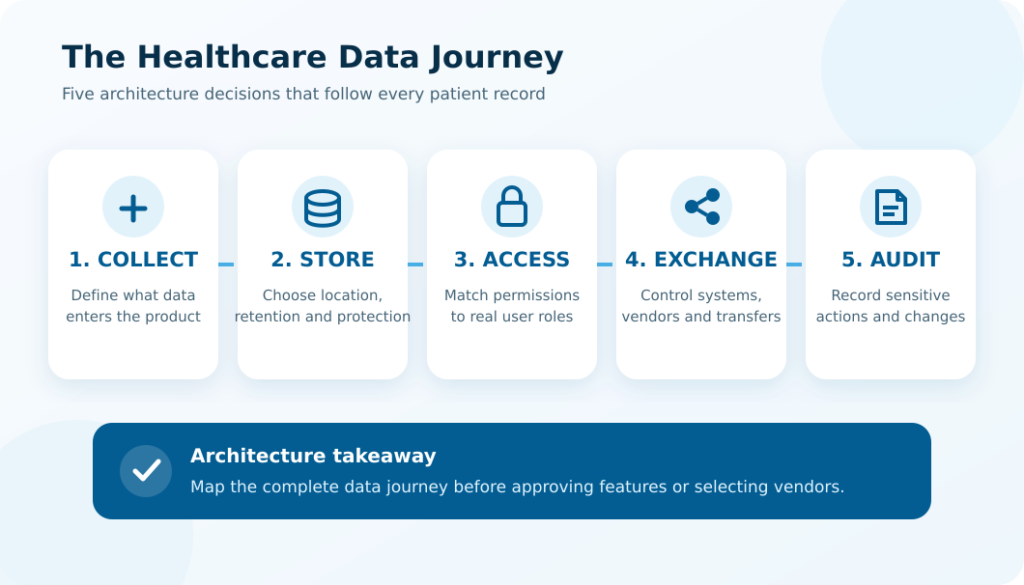
Every patient record follows a data journey. Mapping each stage early helps teams design safer and more accountable healthcare software.
2. Identify the Rules for Each Target Market
There is no single global healthcare compliance checklist.
A US product may need to consider HIPAA and HITECH. A UK platform may fall within UK GDPR, the Data Protection Act and NHS requirements where relevant.
Products operating in the EU may need to consider GDPR and, depending on their intended purpose, medical-device rules.
In practice, start by defining where the product will operate, what role the company plays and what data it handles. A qualified specialist can then confirm the relevant obligations. The technical team can turn those obligations into clear, testable requirements.
3. Design Access Around Real Roles
“Admin” and “user” are rarely enough for a healthcare application.
A patient, clinician, care coordinator, support agent and organisation administrator may need very different access.
Role-based access control should reflect these real responsibilities, while least-privilege principles limit each person to the information and actions genuinely required.
In addition, teams should assess authentication, multi-factor authentication, session controls and exceptional access according to risk. These controls should protect information without disrupting care delivery.
4. Make Auditability Part of the Product
Healthcare systems often need to show exactly what happened, not merely prove that a database exists.
Useful audit events may record:
- Who accessed sensitive information
- What action they performed
- When it occurred
- Which record or resource was involved
- Whether information was changed or exported
Therefore, teams should protect audit logs, make them searchable and limit the information they contain. Adding auditability after launch may require major changes to APIs, databases and user workflows.
5. Plan Integrations Around the Workflow
FHIR, HL7v2, DICOM and SMART on FHIR are important healthcare interoperability standards, but naming a standard is not an integration strategy.
However, teams still need to answer five practical questions:
- Which system supplies the data?
- Is information moving one way or both ways?
- Who owns patient and provider matching?
- How are failed or duplicate messages handled?
- What happens when the external system is unavailable?
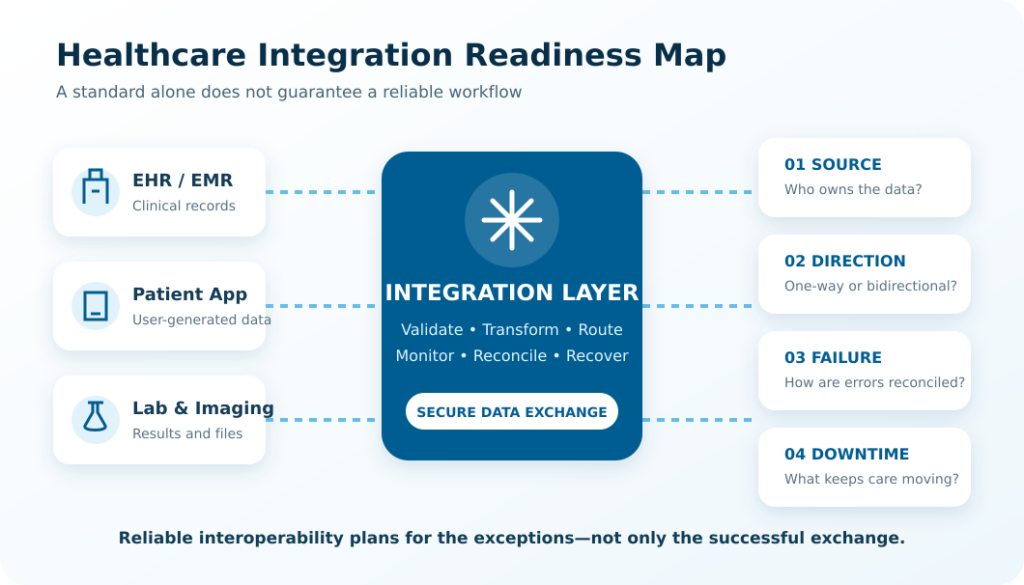
Reliable healthcare interoperability requires more than connecting systems—it must account for data ownership, direction, errors and downtime.
The right healthcare application architecture must handle failures, reconcile incorrect data and monitor every exchange. A successful demo alone cannot prove that an integration is reliable.
6. Review Every Vendor Entering the Data Flow
Cloud infrastructure is only one part of the system. Analytics tools, error trackers, communication services, AI providers and support platforms may also receive sensitive information.
For this reason, teams must review every vendor before integration. They should confirm what data the vendor receives, where the vendor processes it and how long the vendor keeps it.
However, a signed agreement alone does not prove that the chosen configuration is secure or suitable.
7. Build for Procurement as Well as Launch
A healthcare MVP can function correctly and still be unprepared for an enterprise buyer.
Hospitals and healthcare organisations may request architecture diagrams, data-flow documentation, security policies, vendor inventories, penetration-test results, incident-response plans, recovery evidence and relevant agreements or attestations.
As a result, maintaining this documentation gives buyers clear evidence to evaluate. It also helps the development team make consistent decisions as the platform grows.
Healthcare Architecture Readiness Checklist
Before development begins, confirm that:
- Document all data types, flows and system boundaries.
- Identify target markets and relevant regulations.
- Define user roles and access permissions.
- Map every important audit event.
- Validate integration dependencies and failure scenarios.
- Review every third-party vendor.
- Assign owners for backups, recovery and incident response.
- Maintain security and architecture documentation.
The Better Question to Ask Before Building
Therefore, answer this question before early assumptions become expensive development problems.
Thoughtful healthcare software architecture supports compliance, improves resilience and reduces avoidable rework. It also prepares the product for real healthcare partnerships.
Planning a healthcare platform? AveryBit can help you turn product requirements, data flows and integration needs into secure, scalable software built for practical use.












 English
  German